Ask to see the ordinary week
Begin with the timetable. Where does strength training sit relative to technical drilling and hard live work? Who knows what an athlete completed at another club, school or gym? A specialist environment should have a practical way to coordinate those demands. That does not require an expensive dashboard; it does require communication and a clear decision-maker.
Ask how the schedule changes around competition, travel, illness and examinations. The useful answer explains the process rather than promising a single perfect weekly template. Athletes arrive with different experience, training histories and responsibilities. A facility that offers every session to everyone without discussing those differences may be selling access rather than providing a coherent programme.
Inspect the working space around equipment
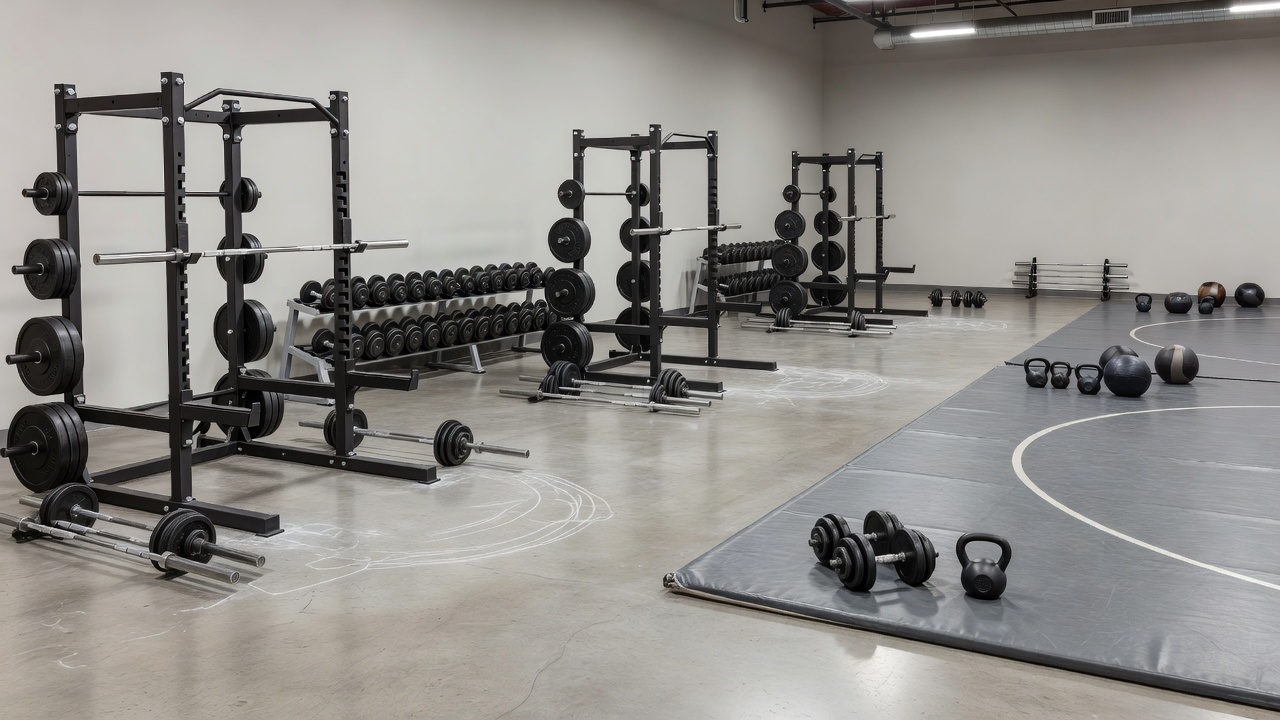
A rack needs more than a footprint. Watch where plates are carried, where a coach can stand and whether another athlete must cross a lifting area to reach water or the mat. Check storage, damaged equipment reporting and the route used when a loaded station is occupied. The same attention applies to sled lanes, ropes, bikes and medicine-ball areas.
Do not infer competence from equipment brands. Ask about the qualifications and experience of the person supervising the session, their scope of practice and arrangements when they are absent. The National Strength and Conditioning Association and the UK Strength and Conditioning Association provide professional reference points. Membership or a credential still needs to be considered alongside actual duties and relevant experience.
Separate preparation from fatigue
A warm-up area should support the next task. Can athletes move without dodging a live pair? Can a coach observe basic movement and adjust the session? If warm-up becomes a crowded holding pen beside the door, extra floor markings may be less useful than changing group flow or session timing.
Likewise, finishing exhausted is not a reliable measure of a successful conditioning session. Ask what the session is intended to develop, how exercise choices are taught and what prompts a change in load. This site does not prescribe sets, repetitions or individual intensity. Those decisions belong with appropriately qualified staff who know the athlete and the wider training plan.
Look behind the recovery label
Recovery provision starts with ordinary access: drinking water, clean changing space, time to eat and a schedule that permits sleep. A cold tub, treatment table or massage device may be visible, but its presence does not establish medical care or a benefit for every athlete. Ask who supervises use, what screening applies and how equipment is cleaned.
The American College of Sports Medicine publishes exercise and sports-medicine resources, while the International Olympic Committee’s medical and scientific work includes athlete-health consensus material. Such references inform professional practice; they do not turn an open recovery corner into a clinical service.
For treatment, ask who is providing it and check the appropriate professional register. In the UK, the Health and Care Professions Council maintains a register that includes physiotherapists. A coach should not be expected to diagnose an injury simply because the facility has a treatment room.
Take weight management out of the sales pitch
A room marketed around sweating, rapid weight loss or “making weight at any cost” deserves particular scrutiny. Deliberate dehydration and extreme restriction can carry serious risks. Ask how the programme handles nutrition questions, who provides individual advice and how younger athletes are protected from pressure. Equipment that increases heat exposure is not evidence of a responsible system.
The sport and development sector offers wider context on athlete welfare, but individual nutrition and health questions need qualified support. For UK anti-doping matters, consult UK Anti-Doping; for international rules and the current Prohibited List, consult the World Anti-Doping Agency. Neither a supplement shelf nor a staff recommendation removes an athlete’s anti-doping responsibilities.
Ask how athletes return
The most revealing route may be the one back from an interruption. Who agrees that an injured athlete can rejoin a live session? How are restrictions passed from the treating professional to the coaching team, with appropriate consent? Look for defined responsibilities and a way to adjust work without isolating the athlete from the group.
A well-organised support area does not promise an outcome. It makes the next appropriate action easier: ask a question, reduce a task, report a symptom or follow an agreed plan. That is a more useful inspection standard than counting machines or admiring a recovery suite.