Begin where the foot catches
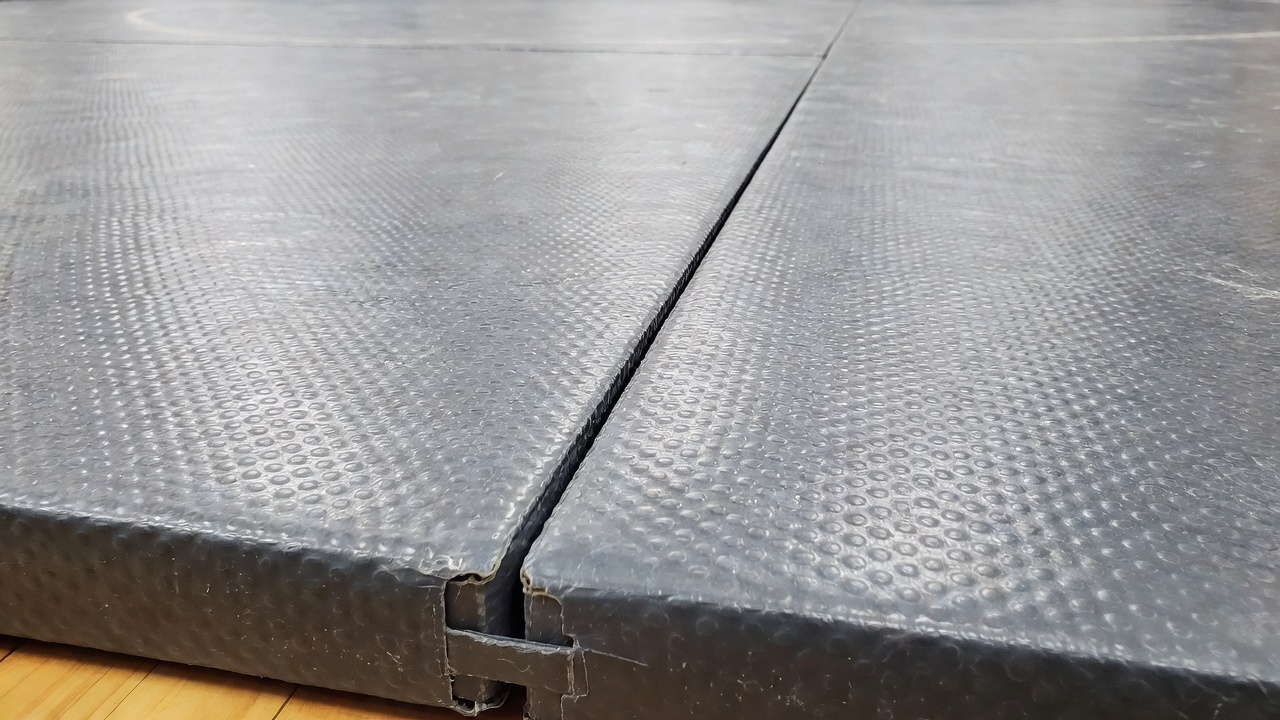
Before warm-up, walk the room with the person responsible for opening it. Look for raised edges, separated sections, damaged tape and changes in level at doorways. A surface that lies flat when empty may move during repeated shots or turn underneath a hard sprawl. Ask how staff check it during a session, not simply whether it was checked at installation.
Keep this inspection within your competence. Do not pull apart a fixed installation or test impact absorption by dropping an athlete. Record the location of a concern, stop use of the affected area where appropriate, and ask the operator or supplier for an assessment. A convincing demonstration is not a substitute for documented suitability.
Separate rules from product evidence
United World Wrestling describes the competition mat and its marked areas in the International Wrestling Rules. The familiar 9-metre wrestling area does not tell you whether a particular training floor, adhesive or wall arrangement is suitable. Equally, a room without competition markings is not automatically unsuitable for every controlled drill.
Ask which ruleset the programme follows. USA Wrestling, the NCAA and the NFHS serve different competition settings. Operators should use the current applicable rules rather than treating all wrestling requirements as identical.
Product evidence answers another question. ASTM F1081 concerns competition wrestling mats; EN 12503-1 addresses safety requirements for gymnastic mats. Neither designation should be casually presented as a universal approval of a complete wrestling room. Request the exact standard, edition, test scope and product identification. The underlying floor and installation method still matter.
Compare the maintenance burden
| System feature | What to inspect | What to request |
|---|---|---|
| Roll-out sections | Joint alignment, curling and movement during use | Approved joining, rolling and storage instructions |
| Panel-based mats | Connection condition and changes at edges | Compatibility guidance and replacement procedure |
| Covered installations | Surface tension, concealed damage and perimeter fixing | Inspection access and compatible cleaning products |
| Wall protection | Coverage, fixings, gaps and nearby hard fittings | Installation details and a room-specific risk assessment |
There is no useful universal winner in this table. A portable system may be necessary in a shared sports hall; a permanent room can remove daily assembly but conceal wear beneath a fixed covering. Evaluate how the actual staff will inspect, clean, dry, store and replace the system throughout the week.
Follow the clean route
Mat hygiene begins outside the training area. Outdoor shoes, bags and cleaning equipment need defined places. Ask whether athletes can reach toilets or changing rooms without carrying contamination back onto the mat. Then observe whether the stated footwear rule is actually followed when a session becomes busy.
The CDC’s athlete guidance on MRSA prevention emphasises personal hygiene, wound care and not sharing personal items. Its guidance for athletic facilities also addresses cleaning shared equipment. These are public-health resources, not a diagnosis of any individual skin condition.
For the surface itself, staff should follow the mat manufacturer’s instructions and the cleaning product’s label, including dilution and required contact time. Mixing chemicals or increasing concentration is not a shortcut. Establish who closes the area during cleaning, who checks that it is ready to reopen and what happens when an athlete reports a possible infection.
Finish at the boundary
Wall padding is only one layer of protection. Look for protruding sockets, radiators, door handles, exposed fixings and changes in padding height. Ask how coaches prevent a scramble from reaching those features. A padded wall must not become a reason to reduce separation between live pairs or to allow uncontrolled finishes into the perimeter.
Finally, ask to see the defect-reporting process. A useful record names the issue, its location, the temporary control and the person responsible for resolution. “We have always trained here” is history, not evidence that today’s surface remains fit for the intended work.
Next observation
Inspect the Space Around the Mat